AI · 3 August 2026
Agentic Team - Room to Grow, Before You're Ready to Hire
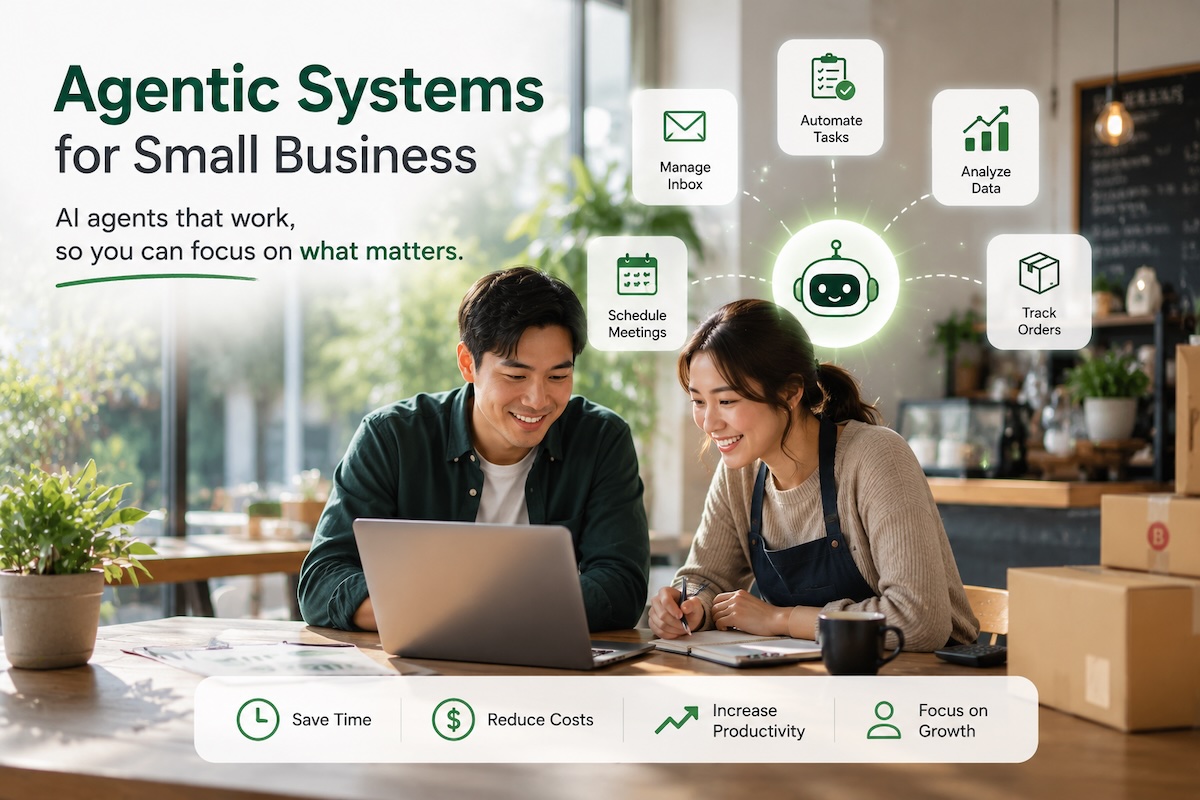
Agentic systems let small business owners scale before they can afford a hire, and keep the business running when a staff member leaves. Here's what that looks like in practice.
Most small business owners often face with two problems: headcount and sequencing. The work that would justify a hire hasn't happened yet, and because there's no one to do it — and the owner is the one absorbing the gap, late into the night.
An agentic system doesn't replace that future hire. It buys you the time to reach them without burning out first — and it solves a second problem most people don't think about until it's too late: what happens to the business when someone leaves.
Problem 1: You can't hire before you have the budget, but the work doesn't wait
The usual advice is "wait until you can afford it." In practice, "waiting" means the owner absorbs the work — quoting, scheduling, chasing invoices, answering the same five customer questions — on top of everything else they already do. That growth phase is a slow burn.
An agentic system — software that can carry out a multi-step piece of work, not just answer a single question — takes on the parts of that load that are repetitive but still require judgment: drafting the first version of a quote, triaging an inbox, following up on a lead, keeping a project brief up to date. Not everything. The parts that were eating evenings.
An agentic system also helps your current team collaborates and stay in context.
This only works with discipline, and it's worth saying plainly: an agentic system is not "set and forget." Someone still has to decide what it's allowed to do on its own and what needs a human sign-off, review its output early on, and correct course when it gets something wrong. That discipline is the thing that lets an owner or manager step back — not the software by itself.
Problem 2: Staff transitions are a quiet, expensive risk
Small teams run on a handful of people who each hold a piece of the business in their head — the client's quirks, the workaround for the finicky supplier, the "oh, I just do it this way" step nobody wrote down. When one of them leaves, that knowledge leaves with them, and onboarding the next person starts from close to zero.
This is where "agentic" earns its keep over ordinary automation. If the workflow — the steps, the judgment calls, the checklist — is already running through an agentic system rather than living only in one person's head, that continuity survives the departure. The system keeps following the process on the day the notice period ends, and the next hire has something concrete to learn from instead of a hurried handover document.
However, there's one caveat: this only helps if the system was already in place before someone left. You can't stand it up during a two-week notice period and expect it to have absorbed years of tribal knowledge. It's a reason to build this earlier than you think you need to, not a rescue plan for a resignation that already happened.
What we mean by "agentic"
We decided to build one for ourselves first. It's called Sycamore.
Sycamore is our own answer to both problems for our software development and maintenance operation, and it's also where we draw on both Anthropic's Claude and OpenAI's models. It's in beta today, running on our own internal projects — a facilities management system and a from-scratch web frontend for ERPNext.
It starts with Lema, an AI Business Analyst who interviews a prospective client and drafts a requirements brief for a human to check before anything gets built. Our human engineering team will then design the architecture and a simple execution plan. With AI tools we stand up the first basic building block before handing it to the agentic system - Sycamore.
Once work starts, Sycamore plugs into the existing project folder we already have (e.g. GitHub in our case) and Lema becomes our team's single point of contact right inside our team chat sessions, such as Rocket Chat, Slack... Behind her, a crew of specialist AI agents — business analyst, system analyst, software engineer, quality, and devops — pick up the work, write code, open pull requests, review each other, and ship. Our team keeps working the way we always have: talking to clients in chat, creating work requests, tracking progress and approving what matters.
Project document folder (in our case it's source code repository) stays the source of truth, and nothing — code or credentials — leaves our own servers. Humans stay in control at the moments that matter: approving gates, reviewing spend, or stepping into a direct conversation with Lema when something needs a person's judgment. Same pattern as the two problems above — agentic development paired with human augmentation, not replacement — just running at the scale of a whole engineering team instead of one business.
Isn't this just Claude or ChatGPT with extra steps?
Claude and ChatGPT are the engine — you still have to drive: ask, copy the answer, paste it into your tools, repeat for every step. Sycamore is the vehicle built around that engine: it plugs into the GitHub project and chat channels you already use, and a crew of specialist agents (led by Lema) picks up the work itself — writes the code, opens the PR, reviews it, ships it — pulling in a human only at the approval gates that actually need one. One's a chat window that answers questions. The other runs the workflow.
Hire.
None of this is about avoiding people — it's about buying the runway to reach them sooner. Every hour an agentic system takes off an owner's plate is an hour that goes back into the business, and eventually, into a hire. That's the outcome worth wanting. We don't want a business that never grows its team, but one that gets to grow it on its own timeline, funded by real headroom instead of guesswork.
So when that budget is there — hire. An agentic system can hold the fort, draft the first pass, keep the process running while people are out. What it can't do is build the relationship, make the judgment call nobody wrote a rule for, or do the work that only gets better with a person doing it. There's no version of this where a human hand isn't worth having the moment you can afford one. Agentic systems just get you there sooner, and in better shape.
Start where you are
You don't need a full agentic platform on day one. However, you do need to know which parts of your business are eating your evenings, and which pieces of institutional knowledge would hurt most to lose. And I have a feeling, you do ;) Those are the two questions we start with.
If either of the problems above sounds familiar, talk to us — we'll help you figure out what an agentic system would actually look like for your business, and what it wouldn't be worth automating yet.
More from Sycamore

What Building 5 Apps with AI Coding Agents Taught Us
What Building 5 Apps with AI Coding Agents Taught Us Real numbers, real challenges, and why the human still matters most. Over the past few months, our team at Linx has been going deep with AI coding agents — specifically Claude Code — across a range of real client projects and our own products.
AI Middleware: The Missing Link Between Business Systems and the Future
In today’s fast-changing digital landscape, artificial intelligence (AI) has become a critical enabler of smarter business operations. Yet, many organizations still struggle to connect their existing ERP and management systems to modern AI models like ChatGPT or GPT-4.
ERP Outsourcing and Implementation Partner for Software Vendors
ERP Outsourcing and Implementation Partner for Software Vendors Deliver ERP Projects Without Building an In-House Team LinxHQ helps software vendors worldwide deliver ERP consultation, implementation, and customization projects on ERPNext.